24Jan

What is a Patient Care Technician (PCT)? Skills, Duties & Benefits 

Working in healthcare is a commendable feat in itself. Yet some roles, such as patient care technicians (PCTs), are essential for the day-to-day patient care. As virtual inpatient support, remote healthcare technicians are equipped to deal with the realities of patients that a regular technician might not be aware of, thus underscoring the physical and emotional intensity of their work. 

Nearly 75% of U.S. physicians now use telehealth regularly. It is driving increased demand for remote clinical support roles such as virtual PCTs. As frontline professionals, patient care technicians end up spending more time with the sick than their surgeons, physicians, and even nurses. Therefore, should you decide to hire one, you must ensure they check all the right boxes of reliable patient care. 


What is a Patient Care Technician?

A Virtual Patient Care Technician (PCT) plays a vital role in supporting patient wellbeing through remote, technology-enabled care. PCTs assist with monitoring patient needs, documenting symptoms or concerns, and facilitating communication between patients and clinical teams. They help ensure comfort, safety, and continuity of care by guiding patients through routine checks, reinforcing care plans, and escalating clinical issues to nurses or providers as needed.

Patient care tech responsibilities include maintaining smooth daily operations by managing virtual patient interactions, updating electronic health records, and supporting telehealth workflows that enhance patient experience and clinical efficiency. 

This role requires compassion, strong communication skills, attention to detail, and a commitment to delivering high-quality care within a modern, patient-centered virtual environment.


Types of Patient Care Technician (PCT)

A patient care technician job falls under the umbrella category of a medical/healthcare technician. Their types depend on what a patient care tech actually does. 

Moreover, virtual PCT job duties extend to being hired for remote patient care. 

The common areas where patient care tech duties and responsibilities are valued are: 

→ Remote Hospital Technician: Provides virtual assistance to hospital care teams. By documenting patient data, monitoring vitals remotely, and communicating updates through EHR systems.

→ Remote ICU Support PCT: Supports critical care units. By tracking patient vitals through remote monitoring systems. Promptly alerting clinical teams to abnormal trends.

→ Remote Emergency Department PCT: Assists emergency departments remotely by managing patient intake documentation, tracking labs and EKGs, and supporting rapid care coordination.

→ Remote Long-Term Care PCT: Monitors residents’ health data, documents daily care activities, and coordinates communication between caregivers and clinical staff.

→ Remote Behavioral Health PCT: Supports mental health teams by documenting patient behavior, assisting with telehealth sessions, and reporting safety or clinical concerns.

→ Virtual Pediatric Patient Care Tech: Provides virtual support for pediatric patients by assisting with symptom tracking, parent communication, and telehealth follow-ups.

→ Remote Radiology Patient Care Tech: Coordinates imaging appointments, manages patient instructions, and ensures accurate documentation before and after diagnostic procedures.

→ Remote In-Home Care Support PCT: Assists home-based patients through virtual check-ins, health monitoring, and ongoing communication with healthcare providers.


What Does a Patient Care Technician Do? Roles and Responsibilities Explained!

A patient care technician encompasses a plethora of responsibilities in a healthcare setting. As the name suggests, they primarily deal with patient care; however, their skills extend from basic daily care to technical care. 

Daily Virtual Patient Support

Provides remote assistance to patients through telehealth platforms. Includes guiding daily care routines, mobility instructions, and basic self-care education.

Remote Monitoring of Vital Signs

Monitors blood pressure, temperature, heart rate, and oxygen levels using remote patient monitoring systems. They also document changes for clinical review.

Digital Sample & Lab Coordination

Coordinates laboratory testing by scheduling sample collections, tracking results, and ensuring accurate documentation rather than performing physical collection.

Clinical Team Support (Remote)

Perhaps the most important responsibility of a patient care tech entails remotely assisting nurses and doctors during procedures and routine tasks. 


Where do Virtual Patient Care Technicians Work?

A patient care technician may work for a hospital, nursing home, assisted living facility, or provide virtual in-home services, depending on their specialty. 

Nevertheless, a patient care technician role is a crucial entity in medicine, without which the healthcare system could not function effectively… 

Essential Skills of a Patient Care Technician

Should a person decide to become a virtual patient care technician, there is a set of technical skills they can acquire via proper training and practice. These include monitoring and recording vitals remotely, guiding and preparing patients for procedures, etc. 

However, there is a completely separate set of skills a PCT must have to actually qualify as one. These are strong communication skills to connect with patients, attention to detail to accurately monitor patients under their care, teamwork as they must work closely with nurses, doctors, and other healthcare staff, and physical stamina to handle long shifts and hands-on patient tasks.  

Essential PCT skills are:

  • Compassionate and attentive in providing remote care.
  • Skilled in digital health tools and patient monitoring.
  • Works effectively with nurses and healthcare professionals online.
  • Clear, respectful, and empathetic interaction across virtual channels.

Qualification requirements usually mention inthe  patient care tech job description are: 

  • Bachelor’s degree required.
  • Prior healthcare or hospital experience preferred.
  • Excellent communication, attention to detail, and ability to multitask in a fast-paced remote environment.
  • Reliable internet connection, basic computer proficiency, and familiarity with telehealth platforms and electronic health records (EHR) systems.

Patient Care Technician vs CNA vs MA: What’s the Difference?

A patient care technician is often mistaken for a nurse or a medical assistant due to the apparent overlap of responsibilities among the three. However, PCTs have a broader scope of skills than the other two and require specialized training. 

While a certified nursing assistant (CNA) is usually trained to perform basic patient care, assisting with Activities of Daily Living (ADLs), a patient care technician deals with advanced clinical tasks along with the CNA duties. A medical assistant takes on more of an administrative role in healthcare. 

While Patient Care Technicians (PCTs), Certified Nursing Assistants (CNAs), and Medical Assistants (MAs) all support healthcare teams, their training, responsibilities, and work settings differ significantly

→ Patient Care Technician (Virtual PCT)

  • Combines hands-on clinical knowledge with remote patient monitoring and telehealth support.
  • Tracks vitals, symptoms, and alerts using RPM tools, EHRs, and clinical dashboards.
  • Supports nurses and physicians across multiple departments simultaneously.
  • Plays a critical role in early intervention, care coordination, and continuity of care.
  • Requires stronger clinical judgment, documentation accuracy, and tech proficiency.
  • More scalable, higher-impact role in modern and future-focused healthcare systems.

→ Certified Nursing Assistant (CNA)

  • Focuses primarily on basic, in-person patient care and daily living assistance.
  • Limited clinical scope; does not independently perform technical or monitoring tasks.
  • Works under direct supervision with minimal documentation responsibilities.
  • Primarily facility-based with little involvement in telehealth workflows.
  • The role is essential but restricted to bedside support.

→ Medical Assistant (MA)

  • Balances administrative and basic clinical duties in outpatient settings.
  • Focuses on patient intake, scheduling, billing, and room preparation.
  • Limited involvement in acute care or continuous patient monitoring.
  • Typically supports physicians rather than nursing teams.
  • Less exposure to inpatient or high-acuity clinical environments.

Why the Virtual PCT Role Stands Out!

→ Extends clinical care beyond physical walls. Through technology.

→ Enhances patient safety through real-time monitoring and rapid escalation.

→ Supports multiple care teams, improving efficiency and workload balance.

→ Represents the most adaptable and future-ready role among the three.


Benefits of Hiring a Healthcare Patient Technician for your Practice!

Patient Care Technicians (PCTs) play a critical role in keeping healthcare facilities efficient, compliant, and patient-focused. They handle essential frontline tasks and offer crucial support to clinical teams, allowing licensed professionals to focus on higher-level medical responsibilities. 

Hence, patient care technician staffing has become a necessity in healthcare settings rather than merely a convenience. 

Most prominent benefits your practice enjoys when you hire a virtual patient care technician are:

  • Improves clinical workflow by handling patient monitoring, documentation, and routine care tasks.
  • Enhances patient safety through consistent vital sign tracking and timely reporting.
  • Increases provider efficiency by allowing doctors and nurses to focus on critical care.
  • Improves patient experience with continuous support, education, and reassurance.
  • Offers a cost-effective staffing solution without compromising quality of care.
  • Strengthens care coordination between patients and clinical teams.
  • Supports growing practices with scalable staffing solutions.
  • Adapts seamlessly to telehealth and remote patient monitoring models.

It is also paramount that such an important role is filled through a reliable patient care technician staffing agency to help healthcare facilities stay agile and ensure patient satisfaction. 


Hire the Right Patient Care Technicians for Your Facility with Health & Jobs!

Whether you need short-term hospital staffing support, long-term placements, or outsourcing, Health & Jobs offers patient care technician shortage solutions in the midst of nationwide workforce challenges. 

It’s more than just filling vacancies…  the right patient care technician must adapt to a fast-paced clinical environment in order to strengthen workflow.

As a program dedicated to delivering tailored clinical staffing services, we are designed to meet the evolving requirements of healthcare settings. 

Patient care technicians at our disposal are screened for both technical competency and workplace readiness. Health & Jobs acutely understands industry demands, helping organizations hire patient care technicians who integrate seamlessly into existing teams. Ready to work from day one. 

Why Hire with Health & Jobs?

At Health & Jobs, we offer a healthcare workforce solution. With us, you will get:

→ Access to pre-vetted, highly qualified healthcare professionals.

→ Specialized recruitment for virtual Patient Care Technicians.

→ HIPAA-compliant candidates. Trained in EHR systems and clinical workflows.

→ Faster hiring process. Offering reduced administrative burden.

→ Trained on healthcare skills, communication ability, and cultural fit for United States healthcare.

→ Cost-effective staffing solutions without compromising care quality.

→ Flexible hiring models. We support short-term, long-term, and remote needs.

→ Ongoing support. It is to ensure a smooth onboarding and workforce retention. 


Schedule your consultation. Partner with Health & Jobs to hire a dependable patient care technician and build a stronger, more resilient healthcare team today!


FAQs

What is a patient care tech?

A patient care technician (PCT) is part of the medical team, trained to provide hands-on patient support and assist clinical staff in healthcare settings.

What does a patient care tech do?

A patient care tech helps with basic patient care, performs vital signs, collects samples, and supports nurses.

What is the difference between a patient care tech and cna?

While both provide direct patient care, PCTs receive specialized training to perform technical tasks such as EKGs and phlebotomy.

Can a Patient Care Technician (PCT) become a nurse later?

Yes. PCTs may utilize their hands-on clinical experience as a stepping stone to pursue nursing programs, after gaining valuable skills and exposure that make the transition smoother.


07Jan

What Does a Healthcare Virtual Assistant Do? Tasks and Duties!

The modern healthcare providers are continuously pressured to provide quality treatment to their patients and to handle administrative pressure. Appointment scheduling to verification of insurance can take hours that could be used by clinicians to attend to patients. 

Clinicians have been found to spend approximately 49% of their time in administration, and this is a major cause of burnout and lack of productivity. This increased pressure has caused the introduction of healthcare virtual assistants as a viable solution. 


What Does A Virtual Medical Assistant Do? 

Virtual Medical Assistant tasks and duties

The medical virtual assistant is programmed to handle a broad spectrum of daily activities that allow healthcare practices to proceed with efficiency. 

Patient Interactions and Follow-Ups

The other major work that is carried out by a medical virtual assistant is to handle patient communication. They receive phone calls, e-mails, and messages on patient portals, address simple questions, and transfer significant information to the healthcare provider. 

Insurance & Eligibility Checks

A medical virtual assistant checks insurance and patient eligibility before the visit to prevent problems with billing in the future. They verify policy information, full payments, and approvals, making sure that the patient and the practice are ready in terms of money. This activity will minimize claims rejection and avoid delays in reimbursement.

Claims Support and Medical Billing

Medical virtual assistants are frequently used to help with billing issues, including charge entry, claims submission, and payment posting. They monitor claim statuses, make follow-ups on unpaid claims, as well as flag any discrepancies to be resolved. Virtual assistants can assist with the billing process by ensuring an even flow of cash and taking the load off administrative personnel.

Scheduling Appointments and Calendar Management

An onsite or remote medical virtual assistant is the one who takes control of bookings, rescheduling, and cancellation of appointments to maintain the calendar of the provider in an orderly and well-operating manner.

They also provide automated reminders, pre-book appointments, and change schedules upon request to minimize no-shows. 


Duties of a Virtual Medical AssistantVirtual medical assistant can be working remotely on healthcare systems

Whereas medical virtual assistant tasks are the actions that assistants perform, duties are their tasks in general, and how they will be incorporated into your practice culture.

→ Electronic Medical Records Management

Maintaining electronic medical records with accuracy and up-to-date information is one of the most important tasks of a virtual medical assistant. They add patient details, post medical reports, and make sure that documentation is accurate and well-structured. Accurate records would aid in improving clinical decision-making and assist practices in staying within the healthcare regulations.

→ Coordination with Healthcare Teams

Virtual medical assistants are significant in the process of organizing communication among healthcare providers, laboratories, pharmacies, and referral partners. They make referrals, order test results, and follow up to maintain continuity of care. This will prevent treatment delays and make treatment more efficient.

→ HIPAA Compliance and Data Security

Privacy of patient data is a very important task of a virtual medical assistant. They operate under protocols that are HIPAA-compliant, and they also utilize secure communication tools and are very strict when it comes to maintaining confidentiality. 

→ Administrative Oversight and Supporting Practice Reporting

One of the major benefits of a medical virtual assistant is that they aid in reporting and administrative control, which prepares operational reports and monitors the key performance indicators. 

These insights assist healthcare providers in tracking appointment trends, billing performance, and workflow efficiency. With their assistance, practices are able to make decisions that are informed without the additional burden of administration.

→ Scheduling, Patient Flow, and Operational Support

Virtual medical assistants working as virtual schedulers manage your appointment scheduling. They also do confirmations, cancellations, and rescheduling to maintain an organized patient flow. 

They help reduce no-shows. Through reminders and follow-ups, while ensuring provider calendars are optimized.

Their involvement improves time management for clinicians and enhances the patient experience by minimizing wait times and scheduling conflicts.

→ Patient Communication and Front-Office Support

VMAs often serve as a primary point of contact for non-clinical patient interactions. 

They can respond to inquiries ASAP. Providing appointment instructions, assisting with intake forms, and guiding patients through administrative processes. 

This clear and timely communication by VMAs can improve patient satisfaction and allow your in-office staff to focus on direct clinical care.

→ Workflow Optimization and Practice Scalability

By handling routine administrative and coordination duties, virtual medical assistants allow healthcare providers to focus on patient care rather than paperwork. 

Their support improves workflow efficiency. Also reduces staff burnout and enables practices to scale operations without increasing overhead costs. As practices grow, VMAs offer flexible, cost-effective staffing support aligned with your increasing needs.

Who Can Be the Beneficiaries of Virtual Medical Assistant Services?

Large hospitals are not the only ones that can use medical virtual assistant tasks and services. Their support can be helpful to a plethora of healthcare providers.

Virtual assistants are frequently employed by private practices and individual physicians to handle the administrative burden without necessarily investing in full-time employees. This enables small practices to run effectively whilst maintaining the overheads at a minimal level.

Specialty clinics like cardiology, dermatology, mental health, and practices of chiropractics also benefit immensely. 

Virtual assistants are able to perform prior authorization, referral management, and specialty billing without complication.

Moreover, when you hire medical virtual assistants, they are of great value to telehealth providers. With the continuous development of virtual care, assistants assist in taking care of online scheduling, patient registration, and remote recordings. 

The studies show that more than 80% of the patients have been using or intend to use telehealth services, having the necessity to be supported with virtual assistance that will help them.


Get the Best Healthcare Virtual Assistants with Health & Jobs! 

Virtual medical assistant managing patient phone calls and inquiries remotleyIndeed, the choice of virtual medical assistant services for healthcare is the key to success in the long term. Health & Jobs is a specialist in offering the best, professional, highly-qualified, skilled, and healthcare-trained virtual assistants that are familiar with the peculiarities of a medical practice. Our personnel are a perfect fit for your virtual medical assistant job description. 

Health & Jobs selects and trains its candidates carefully for all necessary skills for medical virtual assistants to make sure they are knowledgeable in medical administration, EMR systems, billing processes, and communication with patients. Every assistant is trained on the HIPAA-compliant procedures, which will ensure data safety and privacy.


Book a free consultation now!


FAQs

Are medical virtual assistants HIPAA compliant?

Yes, because trained healthcare virtual assistants comply with the HIPAA requirements and have safe systems to manage patient data.

Is my EMR system compatible with a Virtual Medical Assistant?

The majority of the virtual medical assistants are programmed to be compatible with popular EMR systems and can be integrated into the software of your practice.

What does a virtual medical assistant do?

They are involved in planning, communicating with patients, billing, updating EMR, and other administrative healthcare duties.

Who can use virtual assistants?

A virtual medical assistant can be useful to physicians, clinics, telehealth providers, and even specialty practices.

Where do I get a good Virtual Medical Assistant?

Collaborating with other types of specialized providers, such as Healthandjobs, will provide access to trained, vetted, and compliant virtual assistants.


02Jan

Faster, Accurate Healthcare Billing! Hire Remote Billing Coordinator & Medical Billing Specialist

The global medical billing outsourcing market reached $14.10 billion in 2023. It is expected to hit $41.9 billion by 2032. 

Why?

What is the reason behind this fundamental shift in healthcare organizations?

Why medical billing specialists are remotely revolutionizing the administrative backbone of modern healthcare.

Healthcare practices have discovered something crucial. Virtual medical billing coordinators deliver the same precision, often better efficiency, without the overhead costs. They opt to save the cost that drains operational budget, and outsource medical billing coordinators and medical billing specialists, and medical virtual assistants to support their practice. 

Healthcare providers using outsourced billing services can reduce their billing costs by up to 50%. That’s not accounting for the intangible benefits. They have faster claim turnaround, fewer denials, and better cash flow velocity with a medical billing specialist remotely working for them.


What Is a Medical Billing Specialist?

Pre-screened remote billing coordinators ready to support healthcare revenue operationsA medical billing specialist is basically a healthcare VA. Trained to work as a financial translator between healthcare providers and insurance companies. They take clinical documentation, the diagnoses, procedures, and treatments. Further convert them into standardized billing codes that payers understand and process.

They optimize your revenue cycle management process. Handling everything from claim creation and submission to payment posting and denial management. 

Medical billing specialists ensure that every service claim gets accurately documented, properly coded, and successfully reimbursed. Without a medical billing specialist, your healthcare practice would be just treating patients while watching your revenue disappear into administrative black holes.


Medical Billing Coordinator vs. Medical Billing Specialist

A medical billing coordinator and a medical billing specialist represent similar but different specified roles within the revenue cycle management.

The medical billing coordinator coordinates between multiple departments to maintain the RCM flow. They manage medical billing teams, track key performance metrics, and ensure that the entire revenue cycle runs smoothly. 

Medical billing specialists execute the RCM plan. They are hands-on with claim submissions, coding verification, payment reconciliation, and denial appeals. 

A remote medical billing coordinator might coordinate with the entire team of billing and coding. Ensuring consistent quality across all accounts while the medical billing specialists focus on accurate, timely claim processing.


Why Do Practices Need a Virtual Billing Coordinator?

Health and Jobs offering remote staffing solutions for medical virtual assistant and coordination rolesThe virtual billing coordinator serves a specific, strategic function that becomes more valuable as your practices grow. While individual medical billers handle claim processing, coordinators ensure the entire billing operation runs efficiently.


Consider what happens without effective coordination…

Claims sit in different stages across complex systems of revenue cycle management. Some billers follow up on denials immediately, while others let them age. Your documentation requests get lost between departments. Nobody’s tracking aggregate denial patterns or identifying systemic issues.

A virtual medical billing coordinator creates structure. They establish your workflows. Set performance standards, monitor key metrics, and ensure consistent quality across all billing activities.

For startups and scaling practices, virtual billing coordinators provide enterprise-level revenue cycle management without enterprise-level overhead. 

Multi-location facilities benefit from outsourcing a remote medical billing coordinator. They get centralized oversight that ensures consistent billing practices across all practice sites. 

The coordinator also serves as the communication bridge between billing staff and clinical teams, translating each side’s needs and constraints to the other. This alone prevents countless issues that typically slow down your revenue cycles.


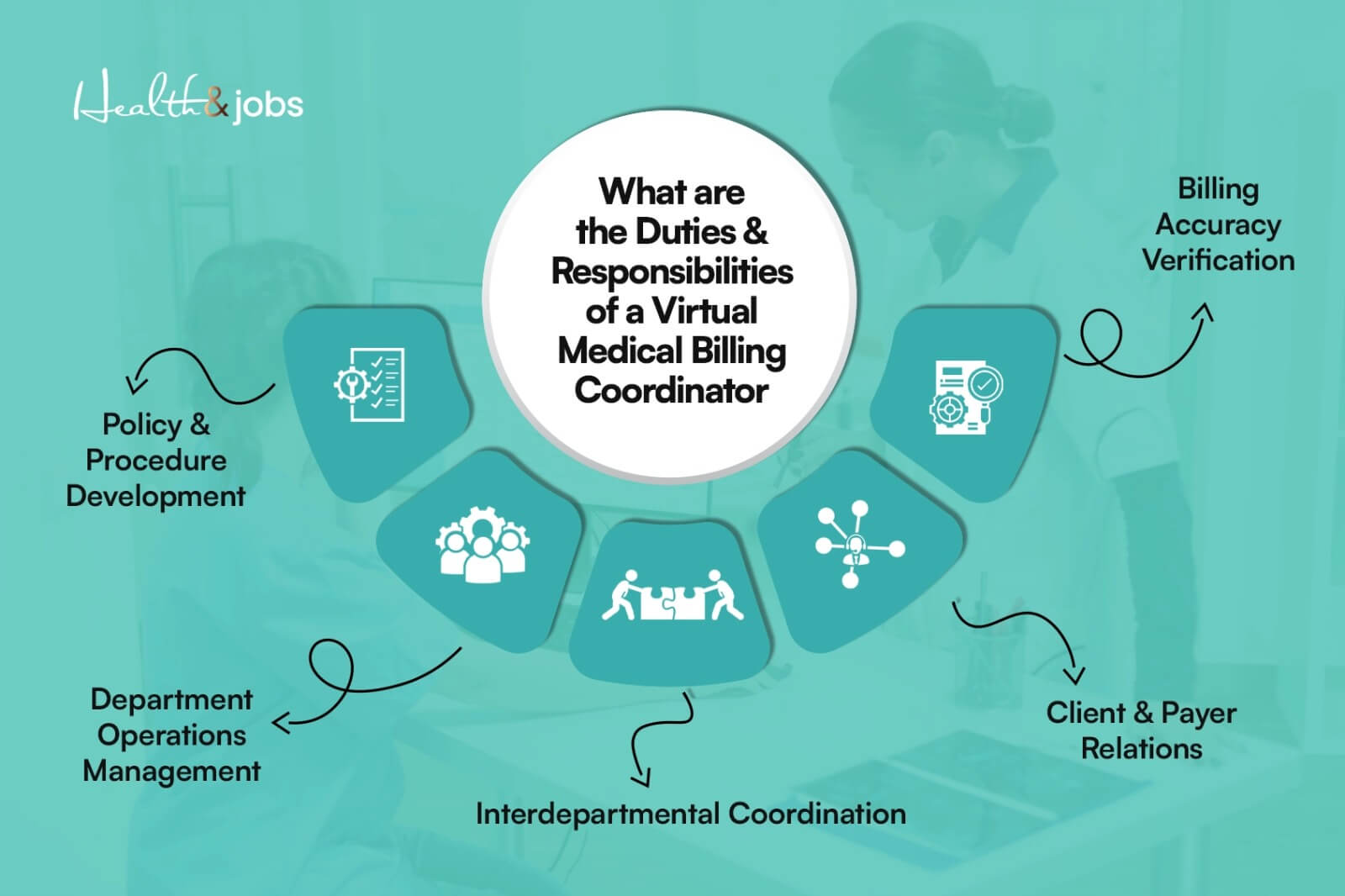
What are the Duties & Responsibilities of a Virtual Medical Billing Coordinator?

Duties of medical billing coordinator

These professionals work with medical billing specialists and are essential for protecting your practice’s revenue. Ensuring accounts are accurate and profits remain consistent. 

A reputable medical billing employment agency like Health & Jobs provides trained professionals. In smaller practices, they might be the sole person doing both medical billing specialist duties and a medical billing coordinator’s duties. 

But in larger organizations, medical billing outsourcing utilizes them to serve as supervisory leaders coordinating multiple team members.

A remote medical billing coordinator’s core responsibilities include:

1. Interdepartmental Coordination

The main responsibilities of a virtual medical billing coordinator are basically to coordinate between departments. It is to ensure billing information accuracy. Serving as the critical communication bridge between clinical teams, administrative staff, and financial departments. 

They translate clinical documentation needs to providers and explain billing constraints to operations teams…

2. Policy and Procedure Development

Creating and implementing billing department policies is about establishing standardized medical billing processes. It is to ensure consistency, compliance, and efficiency. 

When issues arise, medical office billing specialists and billing coordinators develop solutions together that prevent recurrence.

3. Department Operations Management

Billing coordinators oversee all billing department operations. Coordinate with billing associates and sometimes train team members on departmental best practices. 

A remote medical billing coordinator works closely with a medical billing specialist, as they are responsible for the entire RCM operational flow. Including establishing workflows to monitoring performance metrics.

4. Client and Payer Relations

A virtual medical billing coordinator is also skilled to correspond with clients. They answer questions, resolve issues, and follow up on outstanding payments. 

To fulfill their duties and responsibilities, a billing coordinator must have diplomatic communication skills. 

5. Billing Accuracy Verification

Billing coordinators have to review medical billing issues with a virtual medical billing specialist sometimes to resolve issues. They ensure accurate financial records. 

Billing coordinators are involved in conducting regular audits and verifying that charges match documented services. They also ensure coding accuracy before claims submission.


What are the Virtual Billing Coordinator Skills?

A doctor engaging closely with a patient while administrative documentation is handled by a virtual medical scribe.

You need to have a problem-solving attitude and leadership capabilities. Also, the soft skills that enable them to navigate complex medical billing errors:

Qualification. A Bachelor’s degree in healthcare administration, business, or a related field is necessary, with further medical office billing specialist training.

Medical Billing Expertise. To be a remote medical billing coordinator, you should have billing specialist skills. Practices prioritize having candidates’ medical billing knowledge, communication skills, and attention to detail. 

Billing coordinators need a comprehensive understanding of billing processes, not just surface-level familiarity.

Medical Terminology and Coding Knowledge. CPT knowledge, accuracy, and understanding of accounts receivable processes are essential. While billing coordinators might not code claims directly. But still, they need enough expertise to review coding accuracy and identify documentation gaps.

Analytical and Problem-Solving Abilities. Virtual medical billing coordinators should be able to solve problems that arise concerning their work. When payment issues emerge or denial rates spike, billing coordinators must investigate root causes with the billing team and implement effective solutions.

Your analytical ability is a valuable asset that most medical billing employment agencies prioritize while hiring. 

Time Management and Organization. A remote billing coordinator should be skilled in time management. They have to manage their tasks wisely and prioritize executing various tasks, demonstrating strong time management and operations skills. 

Juggling team supervision, client communications, reporting deadlines, and strategic planning requires exceptional organizational capabilities.

Leadership and Interpersonal Skills. For proper coordination with the medical billing team and between departments, you should have advanced leadership and interpersonal skills.

Effective coordinators motivate team members, resolve conflicts properly, and create positive work environments even under pressure.

Technical Proficiency. The medical billing process requires working knowledge of computer systems and relevant medical software. With the ability to learn new programs being a plus. Modern billing involves practice management systems, EHR platforms, clearinghouses, and payer portals. Remote billing coordinators must navigate all of them efficiently.

Communication Excellence. Billing coordinators should be proficient communicators. Since they must communicate with people as part of their work. 

Professionalism and effective communication are necessary medical billing specialist skills. This includes written communication with payers, verbal discussions with frustrated patients, and clear direction to team members.

Attention to Detail.  A virtual billing coordinator should be detail-oriented in their job to avoid payment errors such as overpayment. 

A single misplaced decimal point or incorrect modifier can cost thousands in denied claims or compliance violations.


Where to Find Medical Billing Talent?

Finding qualified billing professionals is easy; you can contact the best medical billing outsourcing companies. 
Multiple options exist, each with distinct advantages depending on your needs.

Medical Billing Recruiting Agencies.

Medical billing recruiting agencies specialize in identifying, vetting, and placing billing professionals in healthcare organizations. These agencies understand the specific required certifications for the United States healthcare standards. They understand the experience levels and technical skills required for different billing roles in your practice.

Working with recruiting agencies offers several advantages:

→ They maintain candidate pools of pre-screened medical billing specialist remote candidates.

→ They handle initial interviews, verify credentials, check references, and present only qualified candidates for your consideration.

→ Your benefit? Time and cost. Medical billing employment agencies typically charge placement fees. Often, a percentage of the hired employee’s first-year salary.

The process is usually less time-consuming, and you get your skilled, trained, remote talent within a few days. 

Medical Billing Temporary Agencies

When you need billing coverage quickly and temporarily, to handle unexpected volume, cover staff absences, or bridge gaps during permanent hiring, medical billing temporary agencies provide project-based or short-term billers.

Medical billing temp agencies maintain rosters of experienced billers available for immediate deployment. 

→ Need someone to handle the claims backlog after your biller’s unexpected departure? A temp agency in the United States can place someone within days. 

→ Planning a system conversion and need extra hands during the transition? Temporary support scales up when you need it and rolls off when you don’t.

The flexibility of medical billing employment agency relationships makes them particularly valuable for practices with variable billing volumes or seasonal fluctuations. 

You’re not committed to permanent headcount increases. With temp agencies, you only pay for the coverage you actually need.


What are the Benefits of Hiring a Virtual Billing Coordinator Over In-House Staff?

You can have many benefits of hiring a virtual billing coordinator, from a trusted remote talent company like Health & Jobs…

→ The financial advantages start with obvious savings. No office space, no equipment, no benefits, overhead beyond compensation.

 For many practices, this alone represents a 40-60% cost reduction compared to equivalent in-house positions.

→ A virtual coordinators often bring broader experience. Having worked with multiple practice types, payer mixes, and billing systems, they can improve your workflow. Making them better based on proven approaches from other organizations.

→ Geographic flexibility matters. With virtual hiring, you’re selecting from a global talent pool rather than settling for any available option within commuting distance of your office.

→ Scalability represents another advantage. Need additional coverage during your busy season or a major clean-up project? Virtual coordinators can often adjust their hours or bring in additional support from their networks.

When volume decreases, you’re not stuck with underutilized full-time staff.

→ Remote billing professionals are productive and dedicated, away from office politics. They often demonstrate exceptional work ethic and quality standards. 

Some practices report that their virtual talent became their best employee. Without office distractions and commute fatigue, many remote workers deliver more focused, efficient output.


Why Hire Through Health & Jobs?

Choosing the right virtual medical billing coordinator or certified medical billing specialist can make or break your practice’s revenue cycle. 

Health & Jobs removes the guesswork and delivers talent that’s already trained, tested, and ready to perform.


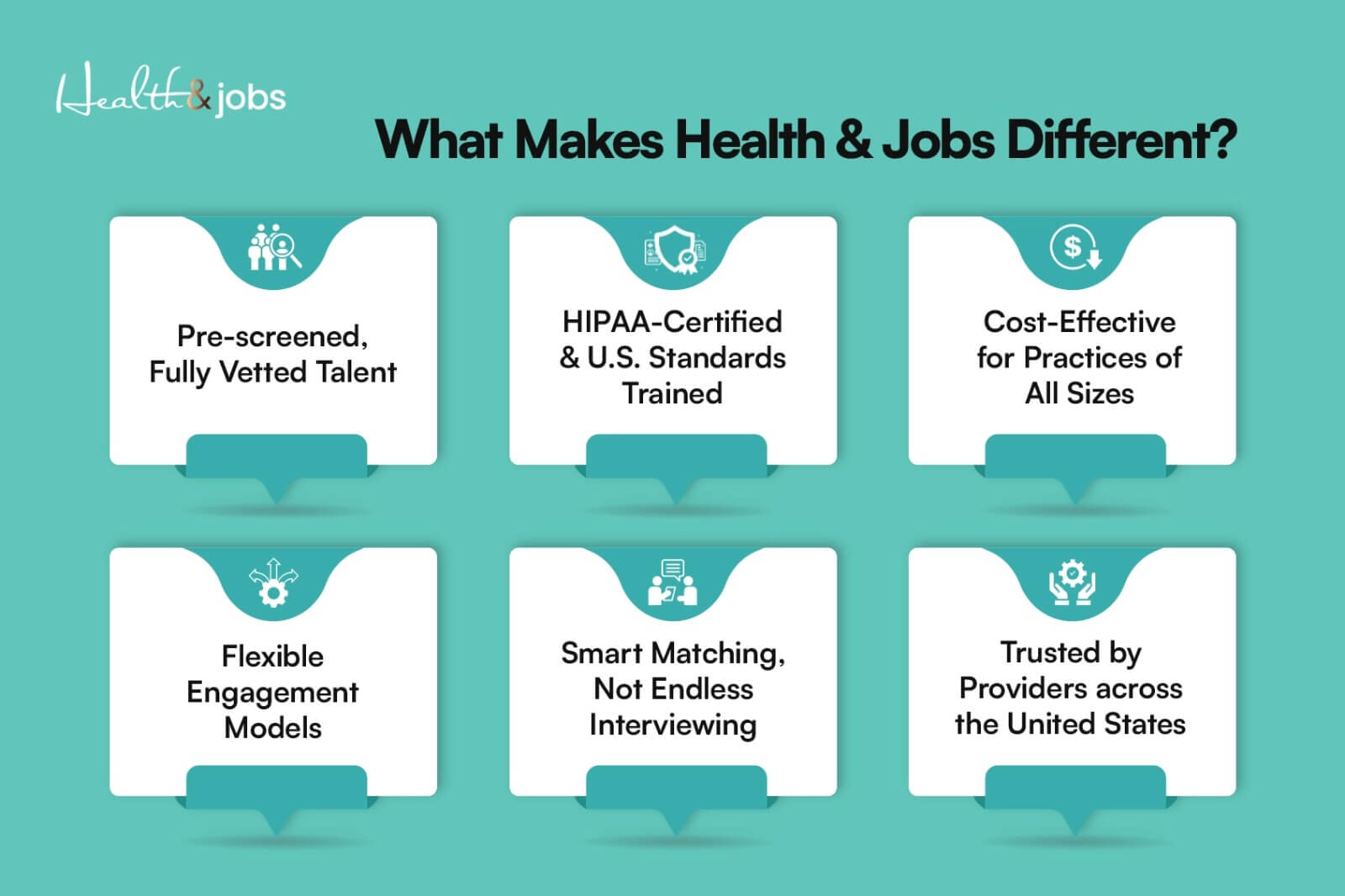
What Makes Health & Jobs Different?

What makes health and jobs different→ Pre-screened, Fully Vetted Talent

Every candidate is evaluated for technical billing skills and accuracy. They have software proficiency (eClinicalWorks, Kareo, Athena, Epic, etc.) and real-world experience across specialties.

→ HIPAA-Certified & U.S. Standards Trained

No need to worry about compliance or onboarding the basics.

We only provide professionals who understand U.S. payer rules, claim workflows, and documentation standards.

→ Cost-Effective for Practices of All Sizes

Our affordable pricing makes high-quality billing support accessible, even for small or newly established practices.

→ Flexible Engagement Models

Hire long-term, short-term, part-time, temporary, or project-based. Whatever fits your operational needs.

→ Smart Matching, Not Endless Interviewing

Our support team learns your practice’s size, specialty, billing software, and payer mix to match you with candidates who truly fit. All faster and more accurately than general job boards or traditional recruiters.

→ Trusted by Thousands of Providers across the United States

We serve healthcare practices in all states in America. 

Our candidates are language and culture-trained to coordinate with clinics, physician groups, and telehealth organizations across the country.

Contact us to get more details. Hire remote billing coordinators & medical billing specialists with Health & Jobs and get the productive, appropriate, and flexible remote support for your practice.


FAQs

What is the difference between a billing coordinator and a medical billing specialist?

A medical billing coordinator oversees entire billing workflows, manages teams, tracks performance metrics, and ensures system-wide efficiency. A medical billing specialist executes hands-on tasks like claim submissions, coding verification, payment posting, and denial appeals. 

How much can practices save by hiring a virtual billing coordinator?

Practices typically save 40-60% compared to in-house staff. Also, the outsourced billing services can reduce overall billing costs by up to 30% through improved efficiency and reduced errors.

Are virtual billing coordinators as effective as in-house staff?

Often more effective. Virtual coordinators typically bring broader experience from working with multiple practice types and billing systems. 

What is medical billing outsourcing, and how does it work?

Medical billing outsourcing transfers entire billing functions to specialized service providers who handle everything from charge entry through payment posting and denial management. The global medical billing outsourcing market is projected to reach $44.30 billion by 2033.

Can small practices afford virtual billing coordinators?

Absolutely. Virtual arrangements eliminate the overhead costs that make full-time billing coordinators prohibitively expensive for small practices.


25Dec

How Virtual Medical Assistant Services for Healthcare Transform Your Practice?

When Dr. Stevens opened his small practice in Texas, he expected to spend most of his time with patients. Not buried in electronic records, insurance claims, and endless calls. The administrative burden was too much to handle. Until he was suggested by a colleague to hire virtual medical assistant services for healthcare.

Within weeks, his calendar was organized. His claims were processed faster. And the best part is his patients were getting the attention and care they deserved.

This shift is not unique at all! 

Across the United States, more physicians and healthcare organizations are hiring remote virtual medical assistants to streamline their operations.  In fact, the virtual healthcare staffing market is projected to grow at a CAGR of over 26.1% by 2030, highlighting how remote talent is reshaping the future of medicine.


What Is a Virtual Medical Assistant?

Remote virtual medical assistant scheduling patient appointments and managing calendars for a healthcare practice.

A virtual medical assistant (VMA) is a trained professional who provides remote administrative and clinical support to medical practices, hospitals, and telehealth providers. From managing patient appointments to handling billing and EHR documentation, a remote virtual medical assistant service for healthcare functions as a key part of a medical team, just without the physical office presence.

Whether it’s scheduling patient appointments, managing medical records, verifying insurance, or supporting telehealth consultations, a healthcare virtual assistant ensures that providers stay organized and patients receive uninterrupted care.

Clinics that adopted virtual assistants saw about 22% fewer missed appointments and 30% faster payment collections, proving their operational impact.

Your medical virtual assistant is a digital extension of your office staff. Professional, skilled, and available remotely to handle time-consuming backend work.


Why Hire the Virtual Medical Assistants Service for Healthcare?

increasing revenue dur to improved financial performance thanks to virtual medical assistant services for healthcare

The benefits of a medical virtual assistant extend beyond administrative convenience. 

1. Significant Cost Reduction

Hiring a remote virtual medical assistant provides all the productivity of an in-house employee at a fraction of the cost. Medical practices can cut overhead expenses by up to 70% by outsourcing to virtual medical assistants.

With a medical virtual assistant, there is no need for physical office space, utilities, equipment, or employee benefits. So, your practice can significantly save on overhead, without compromising service quality.

2. More Time for Patient Care

Patients value responsiveness and smooth communication. When you hire a medical virtual assistant, you get streamlined scheduling, minimized patient waiting times, and follow-ups handled promptly…

This all leads to higher satisfaction scores and patient retention. According to a Webex CPaaS Survey, 76% of patients prefer providers who offer digital interaction and timely responses.  Both of which are core strengths of virtual assistant support.

Tensed medical staff and administrators in a meeting discussing revenue issues and financial challenges in a healthcare practice.

3. Improved Revenue Cycle and Accuracy

Physicians spend 49% of their time on administrative work and EHR tasks. By hiring a medical virtual assistant, doctors reclaim hours for patient interaction. It will definitely result in better satisfaction and improved care quality, and more revenue.

A 2023 report states that healthcare facilities using virtual medical assistant services achieved 30% faster billing collections. It’s all due to fewer claim errors and consistent insurance verifications by a dedicated remote VMA.

4. Reduced Administrative Overload

A virtual medical assistant noticeably helps in decreasing your burnout rate. Admin activities like scheduling, charting, billing coordination, and following up with patients are costly in time. By dropping such routine tasks, physicians and clinical personnel can regain precious time to be able to concentrate on what is important: patient care and outcomes.

Such operational change is not only more efficient but also reduces admin load, which is becoming an issue in the U.S. healthcare systems.

5. Scalability and 24/7 Availability

Remote medical assistants can be found in different time zones. In order that the healthcare providers may be able to lengthen the support hours without incurring extra expenses. The round-the-clock service offered by the trusted virtual medical staffing company guarantees 24/7 support to your practice. It can be after-hours appointments or even patient inquiries during weekends. 

This round-the-clock coverage assists practices in being accessible, which is one of the distinguishing factors in patient satisfaction and loyalty.


What are the Duties and Responsibilities of a Virtual Medical Assistant?

HIPAA-certified virtual medical assistant happily available for patients to answer any queries

A medical virtual assistant is a responsible, extended member of your clinical and administrative staff.  A medical virtual assistant’s tasks include:

1. Administrative Support

  • Control scheduling of appointments, confirmations, and reminders.
  • Maintain and update patient records in EMR/EHRs.
  • Attend to insurance verification, billing, and follow-ups on claims.
  • Carry out proper data entry and transcription of medical notes.

2. Patient Communication

  • Answer the calls, messages, and appointment requests of patients.
  • Share knowledge about processes and guidelines, and post-discharge care.
  • Make post-visit calls to enhance patient satisfaction and retention.

3. Clinical Documentation

  • Help with virtual scribing in the telehealth sessions.
  • Document physician notes, prescriptions, and treatment plans.
  • Coordinate with labs, pharmacies, and diagnostic centers.

4. Reception and Office Services

  • Conduct virtual front desk tasks, such as online mail and requests.
  • Arrange appointments with medical workers and keep physician schedules.
  • Help keep a digital office in order, HIPAA-compliant.

5. Practice Management

  • Assistance in report generation, workflow control, and task coordination.
  • Support patient recall campaign, review, and feedback tracking.
  • Provide streamlined virtual activities that translate to enhanced efficiency and service quality.

6. Compliance and Confidentiality

  • Abide by HIPAA and United States healthcare standards on patient privacy.
  • Make sure that medical data and communications are safely handled on all platforms.

What Skills a Remote Virtual Assistant for Healthcare Should Have?

By recruiting a medical office virtual assistant, you are employing a person who is not only knowledgeable in healthcare but also in technology related to healthcare.

The major capabilities of a medical virtual assistant are:

→ Bachelor’s Degree in Healthcare or Related Field.

→ Good understanding of Patient Interaction Management (Medications, Side Effects, Pharmacy Requests).

→ Expertise in EHR systems, billing systems, and telehealth technologies.

→ Outstanding communication and organizational skills.

→ In-depth knowledge and training of HIPAA compliance and data security.

→ Dedication to precision and care.

→ Capacity to work alone and time management skills.


Hire Medical Virtual Assistant with Health & Jobs: Your Trusted Virtual Medical Staffing Partner

AI tools for executive assistant

At Health & Jobs, we understand that healthcare requires precision, reliability, and empathy. As one of the best medical virtual assistant companies in the U.S., we specialize in providing trained, vetted, and HIPAA-certified medical virtual assistants who seamlessly integrate with your team.

Whether you want to hire a medical virtual assistant for administrative work or a virtual medical office assistant for clinical coordination, we provide professionals equipped to handle every task with confidentiality and care.

Our virtual medical assistant services for healthcare are designed to match medical practices with the right talent… We provide trained staff, specialty-focused, ready to work, for large practices, dental clinics, medical spas, and wellness centers. Our workforce is recruited from highly-qualified, culturally-aligned professionals who understand the requirements of patient care, medical compliance, and data security. 

With Health & Jobs, hiring the right remote virtual medical staffing is all about re-shaping your standard of care.


19Dec

Remote Medical Talent in U.S. Healthcare: Challenges, Benefits & Trends 

None of the workforce shortages in the US were documented as closely as these. A recent AAMC study projects that by 2034, the US will lack 124,000 physicians, as well as numerous other nurses, allied health professionals, behavioral health, administrative support, and healthcare technology positions.   

This isn’t just a shortage of staff within the walls of the healthcare facilities… 

There is a shortage of staff to help manage the care and treatment of people. There is a shortage of healthcare workers who help with the administrative and operational functioning of the care systems. 

staff shortage can affect whole healthcar esystem

Fortunately, this is also where healthcare organizations are innovating. Virtual healthcare professionals support administrative and operational tasks from anywhere in the world. Remote clinical staff have a real positive impact through the support and clinical tasks they perform… 

Now, the staffing of healthcare facilities is no longer the only focus of operational healthcare staffing. The growing use of remote healthcare professionals is a workforce strategy to support the adaptability and competitiveness of primary facilities and healthcare systems overall. 


What are the Health System Challenges in the United States? 

there are many Challenges US healthcare facing today, that cane be solved with remote staffing

Below are the major problems faced by the US healthcare system due to the talent crisis in the healthcare field:

1. Growing Deficiency of Healthcare Employees: The lack of healthcare staff is evident in all fields of healthcare: 

→ Nursing: The American Association of Colleges of Nursing (AACN) reports that the field is expected to lose over 1 million nurses by the year 2030 because of retirement. 

→ Physician: There is a shortage in primary care, internal medicine, psychiatry, etc, due to the retiring workforce and the age demographic of the population. 

→ Allied Health Labor: There is a great deficiency amongst radiology, laboratory technicians, medical assistants, and pharmacy technicians. 

→ Administrative and Support Positions: These positions include medical billing, coding, patient coordination, revenue cycle management, and scheduling, and all of these are experiencing a high turnover. 

The gaps in staffing create operational bottlenecks. This leads to delays in healthcare provision and results in increased burnout of the staff.

2. Healthcare Staff Costs: Healthcare labor costs have been increasing rapidly every year since 2020. Many companies can no longer afford traditional staffing models of in-area hiring, travel nurses, and temporary contracts.

3. Staff Jump: Staff turnover and burnout are driven and increased by excessive amounts of work, overwhelming paperwork, and too little ongoing support. Physicians have to deal with stacks of paperwork, resulting in more than 35% of their time spent on documentation rather than seeing patients.

decrease care standards due to staff shortage4. Rural Healthcare Gaps: There is a shortage of specialists and core health services in many rural and underserved regions of the United States, which creates and worsens health inequities.

5. Inefficient Talent Pipelines: Recruiting, onboarding, and training new staff is extremely time-consuming, and large health systems combined with remote telehealth environments make the telehealth remote staff retention and staffing problem even more complex. 

The remote telehealth provider personnel’s primary staffing management system is directly responding to and solving these major healthcare telehealth staffing management system challenges. 


How Remote Medical Staffing Addresses These Challenges? 

Secure digital platforms enabling remote healthcare staffing for U.S. medical facilities.

Remote talent acquisition enables healthcare organizations to tap into a broader pool of talent, regardless of remote location restrictions.  

Here is how it solves the most relevant issues:

Increasing Availability of Global Talent

Remote staffing allows organizations to engage with new talent from all over the world, therefore having access to the best medical, administrative, and technical expertise continuously, especially when there are no local resources.

Significant Cost Saving 

Remote employees reduce staffing costs by 50–70% compared to in-house roles. Organizations eliminate underutilized overhead costs associated with: 

  • Workplace 
  • Employee benefits and health insurance 
  • Hiring and training new employees 
  • Agency costs and markup for temporary workers 

Such cost advantages provide access to well-staffed staffing for even smaller healthcare organizations.

Less Administrative Work for Providers

Remote healthcare professionals can provide support for: 

  • Patient intake and appointments 

This can help providers focus more on healthcare and reduce documentation.

Increases Flexibility of Workforce 

Remote employees can be added or removed from the team based on the number of patients seen, the time of year, or new types of services offered, eliminating the headaches of standard recruitment processes every time there is a need for change.

virtual dental assistant helping patient online related to dental queries

Improved Access To Healthcare And Patient Satisfaction 

Remote staff allows healthcare organizations to provide: 

  • Communication with patients at any time, day or night… 
  • Appointment scheduling that is more efficient and quicker! 
  • Better processes for telehealth services. 
  • Faster care and assistance after the patient sees a healthcare provider.
  • More patient satisfaction and more positive healthcare outcomes. 

What are the Benefits of Hiring a Remote Medical Workforce? 

Remote healthcare professionals assisting U.S. medical practices with clinical support.

There are many benefits you will get when you hire a remote talent for your practice. You will get: 

  • Cost savings on labor. 
  • Increased efficiency of operations. 
  • Less time spent on administrative tasks. 
  • Improved quality of documentation and compliance. 
  • Increased patient engagement and retention. 
  • Access to various and hard-to-find skills. 
  • Service diversification without the need for additional physical infrastructure. 

→ Advantages of remote support for Doctors, Nurses & Medical Practitioners 

  • Lower documentation demand. 
  • Increased patient interaction. 
  • Improved balance between work life and personal life. 
  • Inclusion of virtual assistants and clinical scribes in daily practice. 
  • Decreased stress and increased levels of burnout. 
  • Assistance with telehealth workflows. 

The Future of Healthcare Staffing in the United States of America!

Healthcare staffing in the United States of America is expected to remain hybrid and digitally global with the following trends: 

After the emergence of virtual-ready healthcare positions, the following positions are mostly modified to fit remote work: 

  • Billers & Medical Coders 
  • Medical Assistants 
  • Customer Service for Healthcare 
  • Clinical Scribing 
  • Data Analysts 
  • Coordinators for Remote Healthcare 

Hire talented, highly-qualified, and trained remote staff with Health & Jobs. Ready to work with you from day one! 


Health & Jobs: Best Remote Healthcare Talent Staffing Company!

HIPAA-certified virtual medical assistant happily available for patients to answer any queries

Our organization has the most extensive and adaptable healthcare staffing solutions available in the industry. 

We provide highly-trained, qualified, global staff to United States healthcare practices, on demand. Our services include: 

Remote Clinical Support Staffing:

  • Virtual medical assistants 
  • Clinical scribes 
  • Telehealth nurses 
  • Billing coordinators 
  • Patient follow-up specialists 

Administrative & Back-Office Staffing 

  • Medical billing & coding 
  • Revenue cycle management 
  • Patient scheduling & intake 
  • Insurance verification 
  • Healthcare customer service 
  • Hr & Payroll Support 

All remote medical professionals have received training on HIPAA, contemporary healthcare technologies, EMR and EHR platforms, and standards in US healthcare. 


How Our Remote Medical Staffing Works? 

health and jobs

Integration, support, and quality adaptability are assured through our processes. 

→ Discovery & Specification. We identify the needs in your staffing, such as role, specialty, hours, certification, and workflow. 

→ Talent Acquisition. We do talent acquisition for healthcare, and we train the highly-qualified staff. We offer to connect you to pre-qualified, remote medical professionals with the appropriate skill level needed for the jobs discussed. 

→ Integration & EMR training. Remote talent incorporation into your existing and current workflows, as well as training on your EMR/EHR, SOPs, and other communication flows, is our responsibility. 

→ Remote Medical Staffing Performance. We monitor key performance indicators relative to documentation, patient satisfaction, claim turnaround time, and overall productivity. 


Why Remote Medical Staffing Should Partner With Us! 

Remote healthcare staff can provide help for billing, scheduling, and documentation support to U.S. clinics.Selecting the best remote staffing partner for your medical practice is a challenge. Here is what makes us stand out from the rest.



1. Healthcare Only! We are not a general outsourcing company. We focus our attention on healthcare-related staff.

2. Extremely Vetted Professionals. 

 All our staff have had the following done on their records: 

  • Background checks. 
  • Skill evaluations. 
  • HIPAA compliance training. 
  • Testing in medical terms. 
  • Assessed on their proficiency in EMR/EHR… 

3. Transparency Without Surprises. There are no hidden fees or agency markup costs on our services.

4. Full Adaptation To Your Workflow. We customize our services according to your convenience for the systems you have in place, business processes, and preferred methods of communication. 

5. Account Management. There is personalized service and a devoted team for ongoing assistance. 

6. Flexible, Reliable, and Scalable. We are able to meet any requirements you have, whether it is a single virtual medical assistant to a complete RCM remote team. We adjust to your staffing needs. 


Get Started: Build Your Remote Healthcare Team Today! 

How about solving staffing challenges and saving costs while improving efficiencies at the same time?  

The answer is simple- partnering with a professional remote medical staffing provider. 

World-class remote medical workers are ready and available to serve your practice at a much lower cost than in-house staffing. 


Contact Now! Build your virtual healthcare workforce today. 


FAQs 

How do healthcare organizations get remote medical staff? 

They partner with a professional healthcare talent agency (like us!) that specializes in remote medical professionals’ healthcare screening, training, and deployment. 

How does remote medical staffing help in reducing healthcare costs? 

Over head costs and recruitment costs get eliminated with remote talent. Hired medical professionals deliver support at highly skilled levels, and costs are lowered. Anywhere from 30-70% vs. industry standards. 

How are your healthcare staffing services different? 

Exclusively healthcare remote staffing, strict vetting, HIPAA-compliance, transparent costing, and easy integration with your workflows. 

What are some of the healthcare positions that can be filled with your staffing services? 

We staff remote medical assistants, nurses for telehealth, clinical scribing, medical coding and billing, patient scheduling, revenue cycle management specialists, technology support teams, etc. 

Do your remote medical specialists know how to use the latest medical technology? 

Yes. All employees have training in current EMR/EHR systems, telehealth applications, compliance with US healthcare regulations, and AI device workflow management systems. 


10Dec

How Remote Talent Can Transform the US Healthcare Market

The American healthcare system is suffering from a serious shortage of healthcare workers. You walk into any hospital, clinic, or medical practice today. You may hear the same story. There are overworked physicians drowning in paperwork. Burned-out nurses are considering career changes, tired of overworking due to the healthcare talent shortage. Most devastating, patients are waiting weeks, sometimes months, for appointments.

The Association of American Medical Colleges (AAMC) studied the healthcare workforce shortage statistics. It shows that the physician shortage can reach 124,000 by 2034. It can create dangerous gaps in patient care nationwide. 

Worker shortage consequently overburdens the available staff, which causes them serious burnout and also compromises patient care. Over 63% of healthcare workers report experiencing burnout. Job stress led many of them to consider leaving the profession entirely.

Clinician sitting tired because of burden of administrative tasks.

Administrative burden has itself become suffocating. A study in Annals of Internal Medicine shares that it consumes 40-50% of clinicians’ time that should be spent with patients. 

Yet there’s a silver lining. Hiring the remote healthcare talent!

Healthcare talent agencies provide trained virtual healthcare staff to support your practice in the most cost-effective manner!

It is a modern, scalable solution. Remote healthcare talent staffing is already transforming how healthcare organizations operate. 


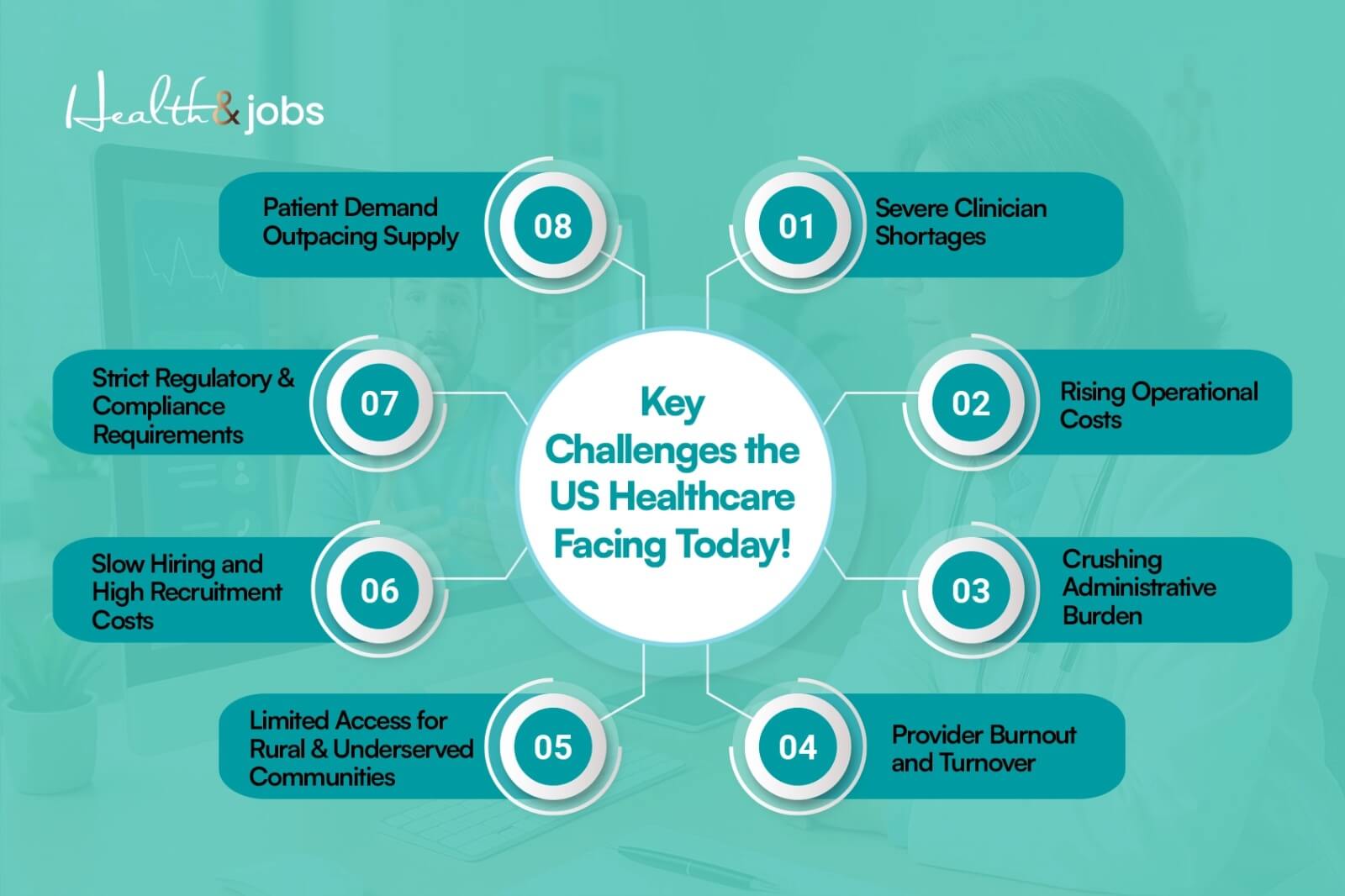
Key Challenges the US Healthcare Facing Today!

Severe Clinician Shortages

America is experiencing critical shortages across every healthcare role. We are desperately short on nurses, behavioral health specialists, primary care providers, and specialists across every discipline. 

Rural areas face the worst impact. Almost 9 out of 10 rural areas in the United States are facing a serious shortage of healthcare staffing. The situation grows more dire as 2 out of 5 physicians are expected to approach retirement age by 2034. Threatening to deepen the crisis just as demand continues climbing.

Rising Operational Costs

Healthcare organizations are bleeding resources. Along with trying to compete for limited talent. Administrative spending alone costs up to 30% of total healthcare costs. It is the money that could be invested in patient care, technology, or facility improvements. 

For many practices, especially in competitive urban markets, these costs are becoming unsustainable.

Crushing Administrative Burden

The paperwork never stops! Between billing, credentialing, EHR documentation, prior authorizations, insurance verification, and compliance reporting, physicians and in-house medical talent spend more time on administrative tasks than on actual patient care.

This is a fundamental problem that reduces efficiency. It also increases errors, causing burnout, and most importantly, compromises the quality of care your patients receive.

Provider Burnout and Turnover

Healthcare workers report significantly more poor mental health days than they did just five years ago. CDC reports, 19% of healthcare staff experience burnout “very often.” 

More than one-third of physicians say they are likely to leave their jobs within the next five years.

Limited Access for Rural and Underserved Communities

According to the June 30, 2024, report, there are over 7,500 designated Health Professional Shortage Areas (HPSAs) across the United States, affecting nearly 75 million Americans. 

Rural communities struggle the most. These communities face physician shortages and also lack supporting clinical staff, limited specialty access, and barriers to basic healthcare services.

Slow Hiring and High Recruitment Costs

Traditional healthcare recruitment is slower than remote talent hiring. Typically, it takes 4-6 months to fill a single position. During that time, existing staff shoulder extra burdens, patient wait times increase, and revenue opportunities are lost. 

Organizations invest in in-house staff onboarding and training. If that person leaves within a few years, the entire expensive cycle starts over.

Strict Regulatory and Compliance Requirements

Healthcare operates under some of the most stringent regulations in any industry. HIPAA compliance, state licensing requirements, credentialing processes, Medicare and Medicaid regulations, insurance protocols… the list is endless. 

One compliance failure can result in massive fines, legal liability, and reputational damage.

Patient Demand Outpacing Supply

The aging US population is causing an obvious increase in the demand for healthcare services. The number of Americans aged 65 and older is expected to rise to 82 million (42% increase) by 2050. 

These older patients typically require more frequent visits. They have multiple chronic conditions and need coordinated care across specialties. 

Demand is accelerating, and the supply of healthcare professionals continues to shrink. It is creating an unsustainable gap in the United States’ healthcare.


How Remote Medical Staffing Solves These Problems?

Remote medical professionals working virtually to support healthcare practices across the United States.

By leveraging qualified remote professionals trained with reputable providers of talent acquisition services in healthcare, practices are reclaiming time for patient care. Remote staffing not only slashes operational costs but also breaks free from the staffing constraints that have plagued the U.S healthcare industry for years.

Remote medical staffing directly addresses each of these critical challenges:

Faster hiring. Means qualified, pre-vetted, highly qualified, trained to work seamlessly, medical professionals can be deployed in 24-72 hours instead of months. 

Your practice need help? You get it immediately. Preventing the downward spiral of overworked staff and declining patient care.

Reduced workload. It can happen, affordably! When your administrative and clinical support tasks are handled by dedicated remote professionals. Physicians reclaim 10-15 hours per week for actual patient care. And your virtual support staff focuses on what they do best.

Cost savings of 30-60%+. It can come when you hire virtual talent, from eliminating office space, equipment, local benefits packages, and facility overhead. 

These are transformative reductions that can improve the financial health of your practice and allow reinvestment in patient care.

Access to specialty expertise. With specialty-trained remote healthcare talent, your practice becomes location-independent.

Need a certified coder specializing in cardiology? A bilingual patient coordinator? A scribe trained in behavioral health documentation? Remote staffing connects you with specialists regardless of where they live.

Increased patient throughput. Hire expert remote talent and experience better scheduling, faster insurance verification, and efficient documentation. It means more patients served without longer hours.

Lower burnout rates. Healthcare workers with trained remote support report significantly better job satisfaction, mental health, and commitment to staying in the profession.

24/7 coverage. By leveraging remote staff from multiple time zones, your practice can run smoothly 24/7. Patient calls get answered, prescriptions are refilled promptly, and urgent administrative tasks are handled around the clock, giving you a good increase in revenue.

Scalable teams. Healthcare talent staffing services provide scalable talent to your changing needs. Expand during flu season. Or scale up for new service lines, or adjust staffing for patient volume fluctuations. All without long-term commitments or major capital investments.


What are the Benefits you Hiring Remote Talent for Healthcare?

clinical assistants providing consultation online with patients

→ For Practitioners

Remote medical staffing gives clinicians what they need most: more time with patients and less time on paperwork. 

Physicians report spending 50-70% more time in direct patient interactions when remote support staff is supporting their administrative tasks. Work-life balance improves dramatically. Instead of staying late to finish notes or coming in early to handle administrative tasks, clinicians can focus on clinical work during work hours.

Want to offer evening appointments? Weekend clinics? Extended telehealth hours? Remote staff makes it possible without overburdening your existing clinical team.

→ For Clinics and Healthcare Organizations

The financial benefits are compelling. Remote talent can help reduce overhead costs. By eliminating office space, equipment, and facility expenses, support staff can save hundreds of thousands of dollars annually for mid-sized practices.

Operational efficiency also improves. Remote medical billing teams specializing in medical claims process submissions are 40-50% faster than generalist staff. 

Patient satisfaction scores consistently rise when organizations implement remote staffing. Faster response times, shorter wait times for appointments, easier scheduling, and more attentive care from less-stressed providers all contribute to better patient experiences. 

Access to a global talent pool removes geographic limitations. You’re no longer constrained by who lives within commuting distance of your facility. With remote staff hiring, the best medical biller in the country could be working for your practice, regardless of where they live.


The Future of Healthcare Staffing in the USA

Remote medical billers and coders managing claims and documentation through secure digital systems.

The transformation of healthcare staffing is already here. 

✔️ Remote and hybrid medical teams are becoming the standard operating model for forward-thinking organizations. If a practice is running successfully today, it’s because they have embraced this shift rather than resisted it.

✔️ Telehealth or telemedicine expansion is also driving explosive growth in remote support roles. 80% of physicians plan to continue telehealth services permanently. 

Virtual nurses, remote medical scribes, telehealth coordinators, and remote patient monitoring specialists are now becoming core team members of healthcare.

✔️  The combination of AI and remote staff is a great and super-efficient combination for healthcare.

AI handles routine tasks like appointment reminders, basic triage questions, and data entry, while skilled remote professionals provide the clinical judgment, empathy, and complex problem-solving that technology can’t replicate. This partnership leverages the strengths of both.

✔️ Outsourced medical billing and clinical documentation are becoming universal. Healthcare organizations recognize this fact. 

Remote documentation specialists deliver higher accuracy, faster turnaround, and better outcomes than asking already-overwhelmed clinicians to handle it themselves. 

✔️ Perhaps most significantly, healthcare is now shifting from location-based to digital-first infrastructure. 

The assumption that healthcare teams must work in the same physical location is now replaced with virtual models that prioritize accessibility, efficiency, and patient convenience while maintaining, or improving, healthcare quality standards.


Health & Jobs: Remote Staffing Services We Offer!

virtual dental assistant helping patient online related to dental queries

At Health & Jobs, we provide comprehensive remote medical staffing solutions most suitable to your organization’s specific needs. We provide:

→ Virtual Medical Assistants. Highly trained, qualified professional VMAs for both clinical and administrative support.

→ Medical Billing & Coding Specialists. Our Specialty-trained medical billing and RCM team is certified and experienced with US payer requirements.

→ Remote Patient Care Coordinators. Work as trained virtual schedulers, managing scheduling, follow-ups, and patient communication.

→ Virtual dental assistants, RNs & Clinical Support. Qualified staff, trained to work remotely as remote dental assistants,  virtual assisted living nurses, and family nurse practitioners. Providing triage, care management, and patient education

→ Telehealth Support Staff. Handling the technical and administrative side of virtual visits as a patient care tech.

→ Medical Scribes. VMSs, experts in documenting in real-time to eliminate the physician charting burden.

→ Front Office & Back Office Medical Admin Staff. Trained virtual HR & payroll assistant, executive assistants, and medical coordinator, providing comprehensive administrative support for healthcare.


How Our Remote Medical Staffing Works?

Getting started is straightforward. Here’s our proven six-step process:

Step 1: Needs Assessment. We start with conducting a comprehensive analysis of your clinical workflows. We observe your administrative bottlenecks, staffing gaps, and organizational goals. 

This helps us understand exactly where and what support you need…

Step 2: Talent Matching. We source highly qualified medical professionals from our vetted talent pool. Then we get you in touch with the matching candidates based on required experience, certifications, language requirements, and cultural fit with your organization.

Step 3: Onboarding & Training. If needed, we provide our remote team workflow training specific to your practice management system, EHR platform, protocols, and organizational culture. 

They learn your standards before day one, to start helping you without any training and onboarding delays.

Step 4: Integration with Your EMR/EHR. Our technical team facilitates seamless setup and integration with your existing systems. Including secure VPN access, appropriate system permissions, and HIPAA-compliant protocols.

Step 5: Dedicated Support. You receive ongoing monitoring, performance management, quality assurance, and optimization from dedicated account managers.

Step 6: Scalable Teams. When your needs evolve then we quickly expand or adjust your remote team size and composition. 

We scale with you based on patient demand, seasonal fluctuations, or new service launches.


Why Choose Health & Jobs?

Remote healthcare administrators coordinating scheduling, authorizations, and patient communication.

Choose us, because we have built our remote medical staffing service specifically for the unique demands of the US healthcare market. \

Here’s what sets us apart:

Our staff arrives HIPAA-trained and compliant. Understanding American healthcare regulations, payer requirements, and clinical workflows from day ONE. 

Every client gets a dedicated account manager. Your manager will be trained to understand your practice, state-specific requirements, monitor performance, ensure quality standards, and provide a rapid response to any of your concerns.

We maintain a pool of highly vetted medical professionals. They have passed our rigorous training, screening, background checks, credential verification, and skills assessments. 

You are getting proven talent, not risky unknowns.

Our fast onboarding process means you get help when you need it. Not months later…

This speed is possible because we maintain pre-vetted talent pools ready for deployment.

Our affordable pricing models deliver 30-60% cost savings. With no compromising quality. We offer flexible structures that work for practices of all sizes.

Health & Jobs provides custom workflows and flexible schedules according to your unique operational needs. 

We ensure consistent quality and long-term reliability when you hire remote talent with us. Our low turnover rates mean you build lasting working relationships with your remote team, not constantly train new people.


Ready to Transform Your Healthcare Operations?

The US healthcare staffing crisis isn’t resolving itself. Physician shortages continue to grow. Burnout rates and administrative burdens expand year after year. 

But healthcare organizations adapting to remote medical staffing are seeing measurable results: 30-60% cost reductions, 10-15 hours per week reclaimed for patient care, critical gaps filled in days instead of months, and improved provider retention and patient satisfaction.

Schedule your free consultation today! Get qualified, HIPAA-trained remote medical staff with ONE-Week FREE trial offer!

Discover how our remote medical staffing can help you reduce burnout, cut costs, and scale your healthcare operations. Our healthcare staffing experts will analyze your specific needs and create a customized solution.

The future of healthcare staffing is remote, efficient, and transforming how American healthcare organizations operate. Your competitors are already making this shift. Can you afford to wait?


FAQs

Are your remote medical staff HIPAA compliant?

Absolutely. All our healthcare professionals complete comprehensive HIPAA training and work within secure, compliant systems with encryption, secure VPN access, and multi-factor authentication.

How can healthcare organizations find remote medical staff?

Healthcare organizations can partner with specialized remote medical staffing agencies. Health & Jobs recruits, screens, and onboards qualified clinicians and administrative professionals.

How does remote medical staffing reduce healthcare costs?

When you hire remote talent, it cuts overhead by eliminating on-site staffing expenses. Also, it reduces turnover and provides access to skilled talent at more flexible, cost-efficient rates.

What makes our healthcare staffing services different from others?

Health & Jobs offers rigorously vetted professionals, fast placement with training in  HIPAA-compliant workflows. Our customized staffing plans are tailored to each practice’s operational needs.

What types of healthcare roles can be filled through your staffing services?

We provide remote medical billers, coders, scribes, RNs, appointment schedulers, prior authorization specialists, and other clinical and administrative roles.

Are your remote medical professionals trained in the latest healthcare technologies?

Yes. Our staff are medical professionals, highly qualified, trained in current EHR systems, telehealth platforms, billing software, and industry-standard digital tools to ensure seamless integration.


29Nov

Virtual Wellness Assistant | Remote Support for Profitable Wellness Care!

A health and wellness virtual assistant is a qualified remote professional usually provided by a virtual wellness staffing agency. They are trained to manage administrative, operational, and client-support tasks for wellness-centered practices. 

With the rapid expansion of services offered in wellness clinics and medical spas, there comes a huge administrative demand. From medical spas and integrative health clinics to nutrition practices, chiropractic centers, and mental wellness providers, the need for dedicated administrative support has never been higher. 

But hiring and training in-house staff for medical billing and administrative work can be costly. Also, it is time-consuming and inconsistent.

That is why more wellness practices are turning to a healthcare virtual wellness assistant. They manage their workflows efficiently. 

virtual wellness assistant handling client messages and bookings for a medical spa

These professionals are similar to medical billing specialists and virtual medical assistants, along with their combined healthcare knowledge. They are familiar with the norms of the wellness industry and the required administrative expertise in medical spas. They help practices operate smoothly while keeping clients engaged and cared for.

Outsource your wellness tasks with Health & Jobs trained & certified Virtual Wellness Assistants… Experts in managing scheduling, client care, and administrative support efficiently…!


What Happens When You Hire a Virtual Wellness Assistant for Your Wellness Clinic or MedSpa?

how virtual wellness assistant will help your practice

Wellness clinics and medical spas often struggle with heavy administrative loads.

Expect this when you hire a virtual wellness assistant:

1. No More Missed Calls, Delayed Responses, or Lost Leads

Most wellness centers lose clients simply because no one is available to answer inquiries on time.

A trained virtual wellness assistant ensures:

  • Immediate responses
  • Consistent follow-ups
  • Faster conversion of leads into paying clients

→ Your front-end communication becomes smooth, attentive, and professional… Because every client will feel valued.

2. Your Providers Finally Get Their Time Back

Practitioners in medspas and wellness clinics often get overwhelmed with:

  • Scheduling headaches
  • Form management
  • Billing queries
  • Client reminders
  • Program onboarding

→ When a wellness VA takes over these tasks, your team is freed. No more administrative pressure. Entire focus on client care, treatments, and business growth. Imagine your revenue!

3. Your Scheduling and Workflows Become Error-Free

Without structured scheduling, a medspa can experience:

  • Double bookings
  • Empty appointment gaps
  • Poorly coordinated service rooms
  • Miscommunication between providers

→ A virtual wellness assistant organizes your entire calendar. The precision ensures every hour is optimized. No more revenue lost due to scheduling chaos.

4. Clients Receive a More Personalized, High-Touch Experience

Clients stay longer with businesses that make them feel cared for. 

A wellness VA provides:

  • Personalized reminders
  • Thoughtful check-ins
  • Clear aftercare instructions
  • Smooth onboarding for membership or wellness programs

→ This level of care increases retention, referrals, and monthly recurring revenue.

5. You Stop Losing Money Due to Disorganization & Incomplete Documentation

Many wellness centers unintentionally lose revenue because:

  • Forms are incomplete
  • Notes are missing
  • Documentation is inconsistent
  • Programs aren’t tracked properly

→ A trained virtual wellness assistant keeps everything updated. Especially since they collaborate with medical billing specialists and understand wellness-related billing and documentation workflows.

6. Your Entire Practice Runs More Professionally!

When your communication, scheduling, documentation, and workflow systems start functioning like a well-built machine, clients notice.

Your practice appears:

  • More organized
  • More responsive
  • More trustworthy
  • More premium

→ This elevates your brand without increasing your workload.


Hire your Virtual Wellness Assistant, NOW!

What Is a Healthcare Virtual Wellness Assistant?

remote wellness assistant providing administrative help to a health clinic

A health and wellness virtual assistant works remotely with medical spas, lifestyle medicine clinics, holistic health facilities, and integrative wellness providers to streamline operations while preserving the human touch clients expect.

Unlike general virtual assistants, wellness VAs understand clinical terminology related to medical spa service structures. They understand wellness program protocols, informed consent processes, ethics, and communication norms specific to patient-facing wellness environments.

Many virtual wellness assistants are additionally trained to collaborate with medical billing specialists and support billing services. Especially for hybrid wellness and medical practices that require accurate documentation, membership billing, or insurance-linked services.


Why Healthcare Practices Hire a Virtual Wellness Assistant?

Medspa and wellness businesses run on consistency, communication, and client satisfaction. Yet practitioners often get stuck handling administrative tasks that drain time and energy. 

When you hire a virtual assistant for health and wellness professionals, it solves this problem immediately by shifting operational tasks to trained experts.

A virtual wellness assistant supports:

  • Medical spas
  • Wellness clinics
  • Weight-loss centers
  • Holistic and naturopathic practices
  • Chiropractic clinics
  • Functional and integrative medicine offices
  • Yoga, fitness, and health-coaching businesses

Whether you manage one location or multiple service lines, the right VA ensures your practice stays organized, compliant, and client-friendly.


What are Virtual Wellness Assistant Duties?

A wellness assistant for healthcare can support numerous tasks depending on what your practice needs. 

Core responsibilities typically include:

1. Client Communication & Engagement

Wellness professionals rely on consistent communication to retain clients. Virtual wellness assistants handle:

  • Appointment reminders
  • Follow-up messages
  • Pre-care and after-care instructions
  • Membership or package renewal notifications
  • Wellness program onboarding

Their communication style is trained to align with medical spa norms, professionalism, and patient-centered ethics.

2. Scheduling & Calendar Management

Wellness facilities often manage high-volume scheduling with multiple service types. A trained virtual wellness assistant organizes:

  • Appointment booking
  • Class or group session registration
  • Provider calendars
  • Service coordination across departments

This ensures smooth client flow and reduced scheduling conflicts.

3. Administrative & Operational Support

From documentation management to supply coordination, virtual wellness assistants take charge of your administrative load:

  • Intake form processing
  • Chart preparation
  • Email management
  • CRM updates
  • Social media coordination
  • Inventory reminders

Their organizational skills free practitioners to focus on service delivery, not paperwork.

4. Wellness Program Support

Many wellness centers offer structured programs such as:

  • Weight management plans
  • Hormone therapy programs
  • Nutritional coaching
  • IV therapy
  • Skin and body wellness packages

Wellness VA recruitment companies provide the necessary training before they join your practice. They maintain your program compliance, track progress notes, and manage communication between clients and providers.

5. Coordination With Billing Departments

Because many wellness facilities also use billing systems for memberships, packages, or hybrid clinical services, VAs regularly collaborate with:

  • Medical billing specialists
  • Billing services providers
  • Revenue cycle support teams

They assist with documentation accuracy, client queries, and understanding wellness-specific billing terminology.


What are the Required Skills & Qualifications of a Health and Wellness Virtual Assistant?

virtual wellness assistant managing online appointment calendar for providers

A high-performing virtual wellness assistant must have:

→ Bachelor’s degree required, Master’s preferred.

→ 3+ years of client-facing or administrative experience in wellness, hospitality, or healthcare.

→ Knowledge of medical spa and wellness clinic terminology.

→ Understanding of informed consent, ethics, and client privacy.

→ Experience with EHRs, CRM systems, and scheduling software.

→ Strong communication and customer service skills.

→ Familiarity with billing workflows and ability to support billing specialists.

→ Organizational, time-management, and multitasking abilities

Wellness practices often prefer candidates with backgrounds in healthcare administration, nutrition, fitness, or spa operations.


Why Outsource Through a Reputable Virtual Wellness Staffing Agency?

Finding the right online wellness assistant is not as simple as hiring a general assistant. 

Wellness businesses benefit from virtual wellness staffing services because agencies specialize in recruiting candidates with healthcare-grade training.

Benefits of working with a wellness staffing agency:

  • They provide pre-screened, certified wellness-trained talent.
  • Wellness staffing services train their candidates with the knowledge of patient communication norms and wellness ethics.
  • You will get faster onboarding of highly reliable and responsible remote wellness assistants.
  • Virtua wellness staffing agencies usually offer flexible hiring options (full-time, part-time, temporary, project-based)
  • You will have no overhead costs, no office space, and no equipment needs.

This makes wellness VA recruitment smoother and more cost-effective for growing practices.


Why Choose Health & Jobs for Wellness Assistant Recruitment?

We are a dedicated virtual wellness staffing agency that connects healthcare and wellness practices with trained, experienced, and ethical remote wellness assistants in Florida and across the United States.

What Makes Our Wellness VAs Stand Out?

virtual wellness assistant handling client messages and bookings for a medical spa

→ Fully vetted, background-checked, and trained in U.S. standards.

→ Familiar with medical spa workflows, wellness programming, and client care etiquette.

→ Coordinated training with medical billing specialists and billing service teams.

→ Skilled in administrative tasks, scheduling, and operational support.

→ Consistent, reliable, and HIPAA-aware

→ Adaptable to any wellness environment, from solo providers to large clinics…

Whether you need part-time help or full workflow support, our wellness VA recruitment model offers flexibility that matches your practice’s size, services, and long-term goals.


Hire a Virtual Wellness Assistant Today!

A virtual wellness assistant is an essential part of creating seamless client experiences in your wellness and medical spa… They will improve workflow efficiency and help you grow the sustainability and financial revenue of your wellness business.

If you’re ready to hire a virtual wellness assistant who understands healthcare, wellness programs, billing coordination, and medical spa standards, Health & Jobs is here to help…

Streamline your operations…

Support your providers. 

Strengthen your client relationships

And let a certified, trained wellness VA handle the rest!


FAQs 

1. What does a Virtual Wellness Assistant do?

A Virtual Wellness Assistant supports wellness clinics, medical spas, and integrative health practices by managing scheduling, client communication, intake forms, follow-ups, CRM updates, and administrative operations. 

2. Why should a wellness clinic hire a virtual wellness assistant instead of in-house staff?

Hiring a virtual wellness assistant offers cost savings. Offers flexibility and specialized training that traditional in-house staff may not have. You avoid overhead expenses like office space, equipment, and benefits while gaining access to certified talent familiar with wellness industry ethics, client care standards, and scheduling platforms. 

3. Are Virtual Wellness Assistants trained in medical spa and billing terminology?

Yes. Professional wellness staffing agencies ensure their virtual wellness assistants understand medical spa service structures, consent processes, treatment terminology, and ethical communication standards. 

4. How do Virtual Wellness Assistants support wellness programs?

Wellness VAs manage your wellness programs. They track your client’s progress. Also, they schedule your follow-ups. They prepare documentation, send reminders, and coordinate between clients and providers.Â