


Running an efficient healthcare practice requires more than skilled physicians. Behind every smooth patient visit is a well-coordinated support team. That support team keeps the medical billing and documentation accurate. They manage workflows organized, and ensure patient care is uninterrupted. Two roles that often cause confusion are medical scribes and medical assistants.
Although both professionals support physicians.. But their responsibilities differ significantly. Understanding the distinction between a medical scribe and a medical assistant helps healthcare employers make informed hiring decisions and allows job seekers to choose a career path aligned with their skills and goals.
What is a Medical Scribe?

As the name suggests, a medical scribe is a healthcare professional who writes. In other words, they are in charge of documenting each step of the patient visit to a physician.
They may also be referred to as healthcare documentation specialist due to the nature of their roles.
Typically stationed next to the healthcare provider, they record the exchange between the patient and the doctor in real-time. It helps in maintaining the accuracy of patients’ medical charts by transcribing exactly what they said during the visit.
Primary Responsibilities of a Medical Scribe
- Document patient visits in the Electronic Health Record (EHR).
- Record medical history, symptoms, diagnoses, and treatment plans.
- Assist physicians with chart completion.
- Prepare documentation for billing and coding.
- Ensure accurate and complete patient records.
Work Environment
Medical scribes’ most common sites of work is offices of physicians, state hospitals – either local or private, and outpatient care centers, among others.
However, virtual medical scribes can be very useful as they eliminate your in-house staff cost, as they may also work from home by listening to live patient-physician encounters via secure video or audio and documenting notes directly into Electronic Health Records (EHRs) in real-time.
What is a Medical Assistant?

A medical assistant is a healthcare professional who supports physicians in handling both clinical and administrative tasks at a medical facility.
Unlike medical scribes, they are in direct contact with patients, aiding with coordinating appointments, managing their records, and handling billing.
The work scope of a virtual medical assistant mostly leans toward administrative operations via telecommunication means and other electronic medical systems.
Primary Responsibilities of a Medical Assistant
- Schedule appointments for patients.
- Communicate with patients via phone calls.
- Manage patients’ electronic health records (EHR).
- Verify patient eligibility for insurance.
- Process patient billing and claims.
Work Environment
The work environment of a medical assistant is similar to that of a medical scribe, working in physicians’ offices, hospitals, and outpatient care centers.
However, those virtual or remote medical assistants working remotely can help your practice. As they are easily scalable and less costly than in-house staffing.
Medical Scribe vs Medical Assistant: Key Differences
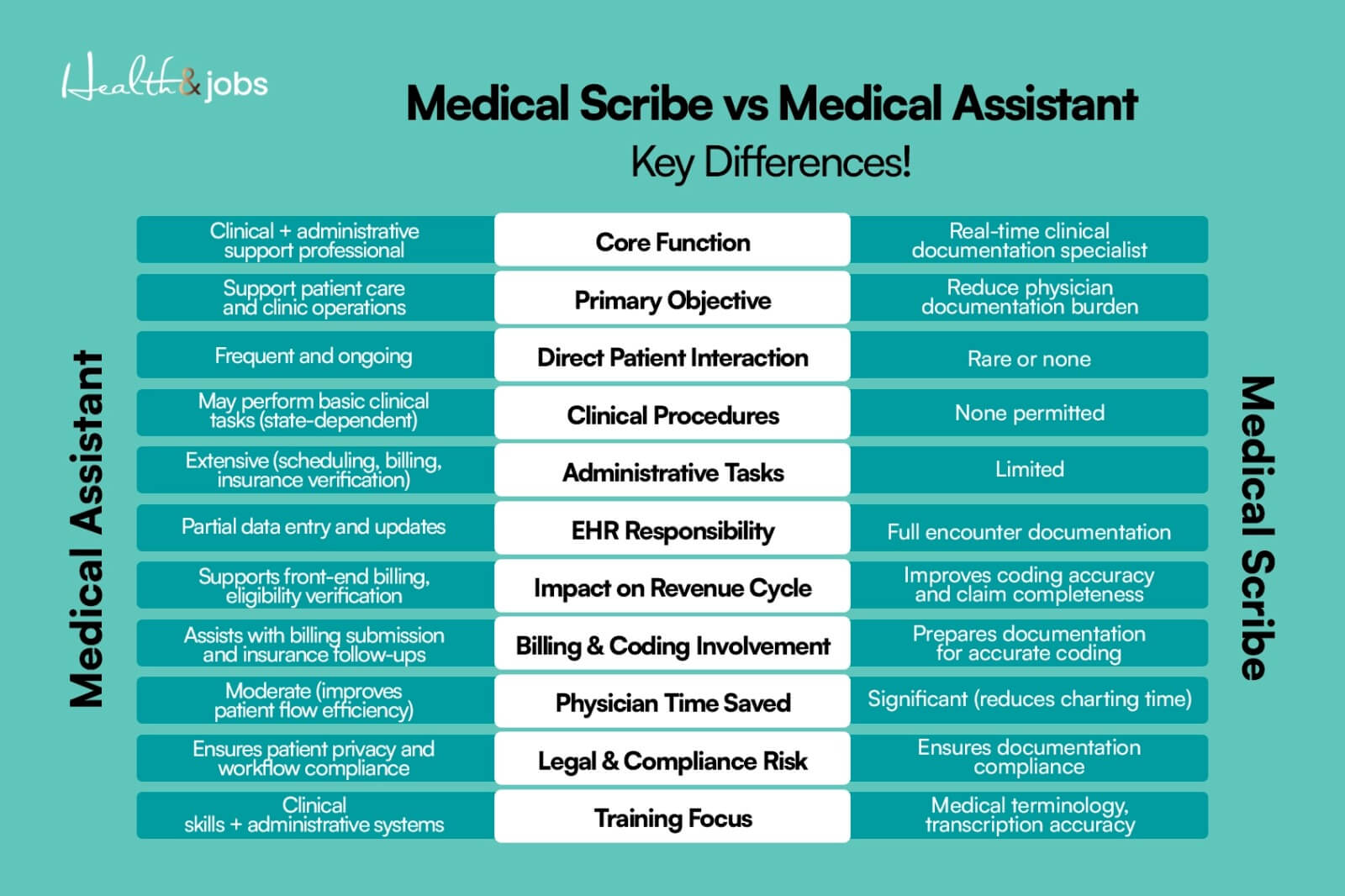
Both medical scribes and medical assistants play a significant role in running a successful healthcare practice. The core difference lies in the nature of their jobs…
Medical scribes offer documentation support to the physicians, while medical assistant is equipped to provide both clinical and administrative support.
Here are some other differences you should look out for before hiring either of them or choosing a career path:
→ Patient Interaction
Medical scribes are not in direct coordination with patients. Instead, they are trained to document patient-physician encounters from the sidelines.
In contrast, whether they are working remotely or on-site, medical assistants are mostly in constant coordination with patients.
→ Clinical Duties
Medical scribes do not have any clinical duties; their scope of work is mostly technical, such as transcribing voice recordings, handling EHRs, and maintaining patients’ medical charts.
Medical assistants, on the other hand, may perform clinical tasks depending on their scope of training and site of work.
→ Documentation Depth and Accuracy
Medical scribes are trained to capture:
- History of Present Illness (HPI)
- Review of Systems (ROS)
- Physical Exam findings
- Assessment & Plan
- Procedure notes
- ICD-10 and CPT-supportive documentation
Their documentation directly impacts:
- Coding accuracy
- Claim approval rates
- Legal protection
- Audit compliance
Medical assistants may enter demographic data, update patient history, or log vitals — but they do not generate full encounter narratives.
→ Purpose
A medical scribe is dedicated to reducing the documentation burden for the physician, so they can aptly focus on clinical tasks.
While a medical assistant helps physicians in both patient care and clinic operations.
→ Operational Workflow Impact
→ A medical scribe:
- Increases patient volume capacity.
- Reduces after-hours charting.
- Improves documentation turnaround time.
- Supports accurate billing.
→ A medical assistant:
- Reduces patient wait times.
- Improves scheduling efficiency.
- Manages front-desk flow.
- Supports insurance verification.
In short:
→ Scribes improve physician efficiency.
→ Medical assistants improve clinic efficiency.
→ Revenue Cycle & Financial Impact
→ Medical Scribes:
- Improve documentation specificity.
- Reduce claim denials due to incomplete notes.
- Support higher reimbursement accuracy.
- Strengthen audit protection.
→ Medical Assistants:
- Verify insurance eligibility.
- Collect copayments.
- Coordinate referrals.
- Assist in claim submission.
Both indirectly support revenue, but scribes impact backend accuracy while assistants support frontend processes.
→ Cost & Staffing Strategy for Employers
From a practice management perspective:
When to Hire a Medical Scribe?
- Physicians are overwhelmed with charting.
- Documentation delays impact billing.
- Burnout is increasing.
- After-hours charting is common.
When to Hire a Medical Assistant?
- Patient volume is increasing.
- Front-desk workload is heavy.
- Scheduling errors occur frequently.
- Clinic flow is inefficient.
Some practices benefit from hiring both for maximum operational efficiency.
Comprehensive Comparison Table | Medical Scribe vs Medical Assistant
| Category | Medical Scribe | Medical Assistant |
| Core Function | Real-time clinical documentation specialist | Clinical + administrative support professional |
| Primary Objective | Reduce physician documentation burden | Support patient care and clinic operations |
| Direct Patient Interaction | Rare or none | Frequent and ongoing |
| Clinical Procedures | None permitted | May perform basic clinical tasks (state-dependent) |
| Administrative Tasks | Limited | Extensive (scheduling, billing, insurance verification) |
| EHR Responsibility | Full encounter documentation | Partial data entry and updates |
| Impact on Revenue Cycle | Improves coding accuracy and claim completeness | Supports front-end billing, eligibility verification |
| Billing & Coding Involvement | Prepares documentation for accurate coding | Assists with billing submission and insurance follow-ups |
| Physician Time Saved | Significant (reduces charting time) | Moderate (improves patient flow efficiency) |
| Legal & Compliance Risk | Ensures documentation compliance | Ensures patient privacy and workflow compliance |
| Training Focus | Medical terminology, transcription accuracy | Clinical skills + administrative systems |
| Career Trajectory | Pre-med, PA, nursing stepping stone | Long-term allied health career option |
| Remote Work Feasibility | Highly adaptable to virtual model | Mostly administrative tasks adaptable remotely |
| Burnout Reduction Impact | Directly reduces physician burnout | Improves operational stress management |
Strategic Hiring Insight for Healthcare Practices!
If your goal is:
- Reduce physician burnout → Hire a Medical Scribe
- Improve patient experience → Hire a Medical Assistant
- Optimize revenue and workflow → Consider both!!!
The right decision ultimately depends on your practice’s operational pain points.
Education and Certification Requirements

A high school diploma or equivalent is a prerequisite for both medical assistant and medical scribe. Further education requirements for medical scribes usually vary depending on employer demand.
However, a foundational knowledge of medical terminology, anatomy, and physiology is typically required to accurately document patient encounters. They should also be trained in performing technical tasks, such as handling EHR systems. Certification is optional.
In addition to a high school diploma and basic medical knowledge, certifications or degrees in medical office administration and health information services are usually helpful in landing a job as a medical assistant.
HIPAA training is mandatory to ensure patient privacy compliance.
→ Health & Jobs provides pre-vetted, trained, HIPAA-Certified working professionals ready to help your practice from DAY ONE!
Essential Skills for Medical Scribes
 There are a number of skills required to make a name as a medical scribe in a competitive world of healthcare.
These include, but are not limited to:
1. Medical Terminology Knowledge
A medical scribe must be able to comprehend the anatomy, physiology, and medical jargon while listening to a patient-physician encounter for fast, accurate note-taking.
2. Technical Proficiency
One of the non-negotiables for a medical scribe; Should have a comfort-level understanding of EHR systems and telecommunication tools.
3. Communication Skills
A medical scribe must consistently communicate and clarify information to providers, thus requiring clear, professional, and concise communication skills.
4. Attention to Detail
As an active listener, a medical scribe has the ability to listen, process, and document critical information from a patient-physician encounter in real-time or from audio.
5. Respect for Privacy and Confidentiality
Regardless of the role, a healthcare professional is HIPAA compliant, strictly adhering to data privacy regulations.
Essential Skills for Medical Assistants

The skills of a medical assistant may vary according to their working location. A virtual medical assistant is typically bound to administrative tasks and require following skills:
1. Medical Knowledge
Whether on-site or remote, a medical assistant must be accustomed to medical terminology and basic medical procedures.
2. EMR/EHR System Proficiency
As a remote medical assistant, they must be able to navigate, update, and manage Electronic Medical/Health Records (EMR/EHR) for smooth patient record maintenance.
3. Communication Skills
Medical assistants are in direct coordination with both patients and providers; therefore, they must be clear and empathetic in how they communicate.
4. Regulatory Knowledge
As a HIPAA-compliant healthcare professional, medical assistants must understand and adhere to the privacy standards of the state.
5. Organizational Skills
Medical assistants must possess strong skills in appointment scheduling, calendar management, email management, and task prioritization to avoid last-minute hassles.
Which Role is Right for You?
Choosing the right career path may feel overwhelming in the wake of two similar yet distinct medical roles. However, one can decide the best course of action by having a clear outlook on their goals.
For example, if a job seeker is interested in documentation and prefers to stay on the sidelines rather than participate in hands-on clinic operations, a medical scribe is gold for them.
Meanwhile, a medical assistant is in constant communication with providers and patients, and is more on the front-end of healthcare operations.
→ Thus, if you prefer a clinical environment to showcase your administrative skills, then a medical assistant is the right choice.
Why Healthcare Practices Hire Virtual Medical Scribes?

There has been a rising trend in hiring virtual medical roles, including medical scribes, due to a number of reasons.
In addition to cost savings on staffing, space, and equipment, working remotely has been known to increase productivity due to a lack of burnout.
A medical scribe can efficiently document encounters between patient and provider from the comfort of their home.
A physician’s workload is also significantly reduced due to the delegation of time-consuming documentation to the virtual medical scribe.
Why Healthcare Practices Hire Virtual Medical Assistants?

Medical assistants play a crucial role in supporting the clinical and administrative workflow of a healthcare facility.
Remote assistants help these practices grow and handle more work, minimizing the need for hiring more in-office staff.
Virtual medical assistants are typically tasked with scheduling appointments, verifying billing and insurance, and updating records – all of which they can do without requiring a formal workspace.
By handling all of the administrative tasks, they promote productivity with effective time management.
Hire Skilled Medical Scribes and Medical Assistants with Health & Jobs!

Healthcare practices today are inundated with administrative pressure and documentation requirements atop clinical duties. A limited budget makes hiring and training in-house staff time-consuming and expensive.
Health & Jobs helps overcome this challenge by providing highly trained remote staff, including virtual medical scribes and medical assistants.
Healthcare staff at our organization is effectively trained in handling both administrative and clinical workflows, along with a strong command of HIPAA regulations.
As the best virtual staffing agency in Florida and the United States, Health & Jobs offers personalized solutions based on the unique needs of each practice.
Whether you need documentation support, administrative assistance, or both, our trained virtual staff can help to improve productivity, reduce burnout, and support your practice growth.
Contact Health & Jobs today to connect with skilled professionals who integrate seamlessly into your existing workflow.